
Reading fluency is the missing piece in the new reading plan
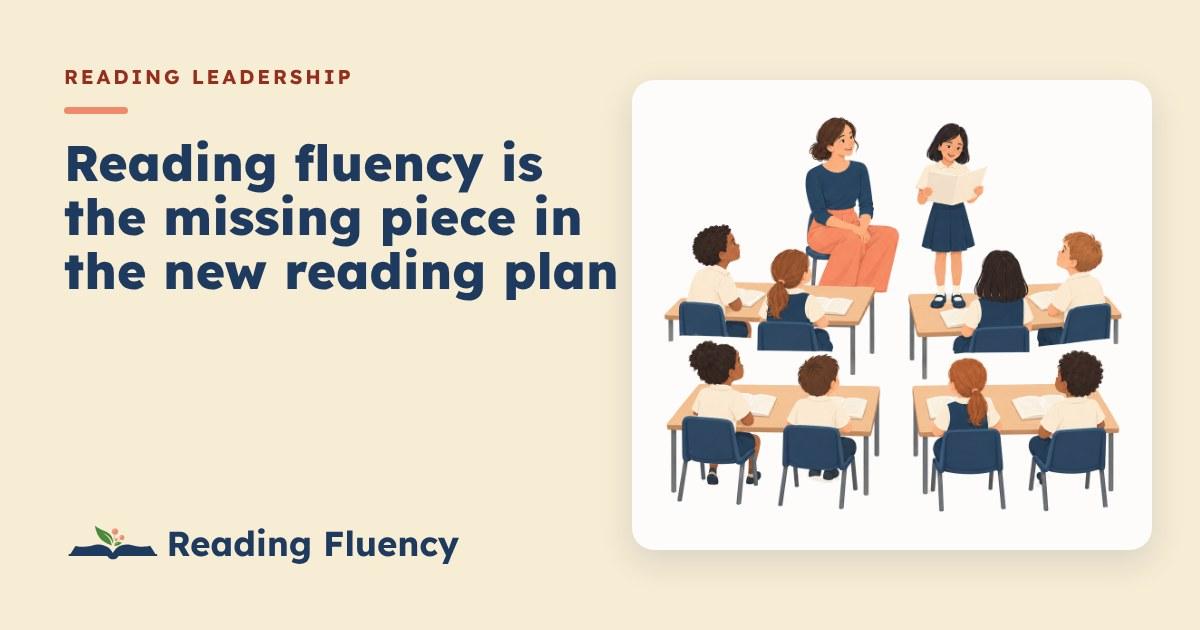
On Monday, the Education Secretary is set to tell Parliament something I've been saying for years: "Reading fluently is the gateway to lifelong learning, opening up every subject in school."
I agree with every word. And I want to hold the government to it.
What's being announced
Primary schools are to be told to set aside time every day for children to read for pleasure. Secondary schools will get weekly time for longer books. Year 8 pupils will sit a reading assessment. And there's a goal for 2035: at least 80% of children reaching the expected standard in reading at the end of Key Stage 2, with the gap for disadvantaged children halved.
Here's where we are now. In 2026, 75% of children met the expected standard. For disadvantaged children it was 63%, against 81% for their classmates. An 18-point gap.
The new curriculum promises children "regular opportunities to build their reading fluency", and higher expectations for reading fluently. Good. But an opportunity isn't a plan. And that's the part I want every head and English lead to think hard about.
What I believe
Fluency is the missing piece between phonics and understanding. I believe that because I've watched it in my own school.
Over the last two years, more than 90% of our children have passed the phonics screening check. That's the work of a brilliant staff team, and I'm proud of it. But a good number of those children used to read word by word. They could decode almost anything you put in front of them. They just couldn't do it easily enough to think about what it meant.
So we started teaching fluency on purpose. Many of those children now read in phrases, with expression, and with time left over to think. Not every child, and not every day. But it's a difference you can hear.
The phonics check tells us at six whether a child can decode. The reading test tells us at eleven whether they understood. Nothing in between asks the question that matters most for those five years: can this child read easily?
So here's what worries me about daily reading for pleasure. For a fluent reader, twenty minutes with a good book is the best thing in the school day. For a child still working at every word, it's twenty minutes of looking at a page, turning it when everyone else does, and hoping nobody asks. You can't enjoy what you can't do.
Give every child the time but only some of them the fluency, and the 18-point gap doesn't halve. It grows.
What schools can do now
None of this needs new money. It needs a decision.
- Listen to every child read, every term. Two or three minutes, one child, a passage they haven't seen. Note their accuracy, their words correct per minute, and whether they read in phrases or word by word. It's the only way to know who the reading time is working for.
- Teach fluency on purpose, from Year 2 to Year 4. Not more phonics, and not more comprehension questions. Short passages read again and again, modelled first, echoed back, marked for phrasing, and performed.
- Protect the reading time for the children who aren't there yet. Pair them with a book they can read at 95% accuracy or better. Read to them. Let them re-read something they already know. The goal is the same for every child, which is to enjoy it. The route there is different.
- Track the gap where it opens. If your disadvantaged children are behind at eleven, they were behind in fluency at seven. Look for it at seven.
Why I'm confident
Ofsted said it in 2024. Their English report, Telling the story, found schools teaching accurate decoding and then stopping there: pupils "do not always have sufficient practice" to read fluently, and comprehension questions get used in place of that practice.
The research has said it for fifty years. LaBerge and Samuels argued in 1974 that a reader has one pool of attention. Every word a child has to work out takes attention away from the meaning. That's why a child can read every word correctly and still not understand the page.
And on Monday the government will say it too. Reading fluently is the gateway.
So let's treat it like one. Not as an opportunity that might happen, but as something every child is taught and every school checks.
What would change in your school if you knew, by name, which children can't yet read easily?
LaBerge, D., & Samuels, S. J. (1974). Toward a theory of automatic information processing in reading. Cognitive Psychology, 6(2), 293–323.
Ofsted (2024). Telling the story: the English education subject report. Available at gov.uk.
Want to talk about fluency in your school?
Drop me an email: simon@readingfluency.co.uk
Or find me on LinkedIn: Simon Sharp
Tags:

Stay in the loop
Weekly reading fluency insights from a serving headteacher. No spam, just practical strategies for your school.
Related Articles
The Year 8 Reading Test: Why Primary Schools Should Care
The government has announced a statutory Year 8 reading test assessing fluency and comprehension. The children it will measure are in your school now, and the gap it will find is set long before Year 7.
Repeated reading: the technique everyone knows and nobody enjoys
Repeated reading is the most evidenced fluency technique there is, and the most boring as usually taught. The fix: hide the repetition inside a week of varied, purposeful tasks with a performance at the end.
Why more reading comprehensions won't fix comprehension
I introduced phonics in four schools and prepared Year 6 classes for their reading SATs. Here's what I learned about why comprehension worksheets don't do what we hope, and what actually builds understanding.