
Repeated reading: the technique everyone knows and nobody enjoys
Repeated reading is a fantastic, well evidenced method for building reading fluency. It is also, as usually described, one of the most boring things you can ask a child to do. Read this passage. Now read it again. Now a third time, and let us see if you got faster. The research behind it is solid, going back to LaBerge and Samuels in the 1970s, but the standard version treats a child like a stopwatch with legs. No wonder it gets quietly dropped.
But repeated reading does not have to be boring. The power is in the rereading, yes, but nothing in the evidence says the child has to know they are rereading, or find it dull. The boredom is not a feature of repeated reading. It is a feature of doing it without giving the child a reason to return to the text. Change the reason each time, and the same words can be read a dozen times across a week while the child thinks they are doing something new every day. That is the whole trick, and it is what we built our poetry routine around.
Why repeated reading works in the first place
When a child reads a text for the first time, most of their mental effort goes into decoding, working out what each word says. There is little left over for expression or meaning. On the second read, the words are more familiar, so decoding costs less. By the third or fourth, recognition is becoming automatic, and that freed-up attention flows into phrasing, expression and comprehension. That shift, from effortful decoding to automatic recognition, is fluency forming, and rereading is the most reliable way to drive it. Timothy Rasinski's Fluency Development Lesson, which underpins our routine, is built on exactly this principle.
There is one precondition, and it is the thing most often got wrong. The text has to be at the right level. A child rereading a text that is too hard does not build fluency, they build guessing and memorising, because all their effort is stuck on decoding and never becomes automatic. The text must be one the child can already read at around 95% accuracy on a cold read. I have made that argument in full in why making the text harder makes fluency worse. Get the text right, and rereading works. Get it wrong, and no amount of repetition helps.
The problem with the standard version
Most repeated reading routines look like this: read the passage, read it again, read it a third time, record the words per minute, try to beat it tomorrow. The technique is sound, but three things go wrong in practice.
The first is that it becomes a speed contest. The moment a child believes the goal is to read faster, expression collapses and they gabble, because fast and flat is easier than fluent. Speed is a by-product of fluency, never the target.
The second is that it is joyless, and joyless practice gets abandoned, by the child and eventually by the teacher. A routine only builds fluency if it actually happens, week after week.
The third is that the child knows they are doing the same thing over and over, which is precisely what makes it feel like a chore. Repetition that announces itself as repetition is dull. Repetition disguised as a sequence of different tasks is not.
The fix: one poem, one week, a different job each day
Our answer is a routine we call hear it, grow it, show it. It takes one poem and stretches it across a single week, and by the end of that week a child has read the poem many times over, but never twice for the same reason. The rereading is total. The boredom is absent, because every pass has a fresh purpose.
Hear it comes first, and crucially it is not about performance at all. On day one the children meet the poem: an adult reads it aloud with full expression while they listen, eyes up, and then they talk about it. What is it about? Which words are new or surprising? How should it sound, fast or slow, loud or quiet, where would you pause? This is comprehension and immersion before any pressure to read well. The children have now heard the poem read fluently and thought about its meaning, which is the foundation everything else is built on.
Grow it is the middle of the week, days two to four, and it is where the rereading quietly stacks up. The children echo read, copying the adult's expression line by line. They read it chorally as a class, then in guided choral reads chasing one feature at a time, landing the rhymes one day, nailing the full stops the next. They read it in pairs and give each other one kind, specific tip, then read it again with the tip in mind. Every one of these is a reread of the same poem. Not one of them feels like it, because the job changes each time: echo the expression, chase the rhyme, coach your partner, fix the wobble. This is repeated reading doing its work while wearing a different coat each day.
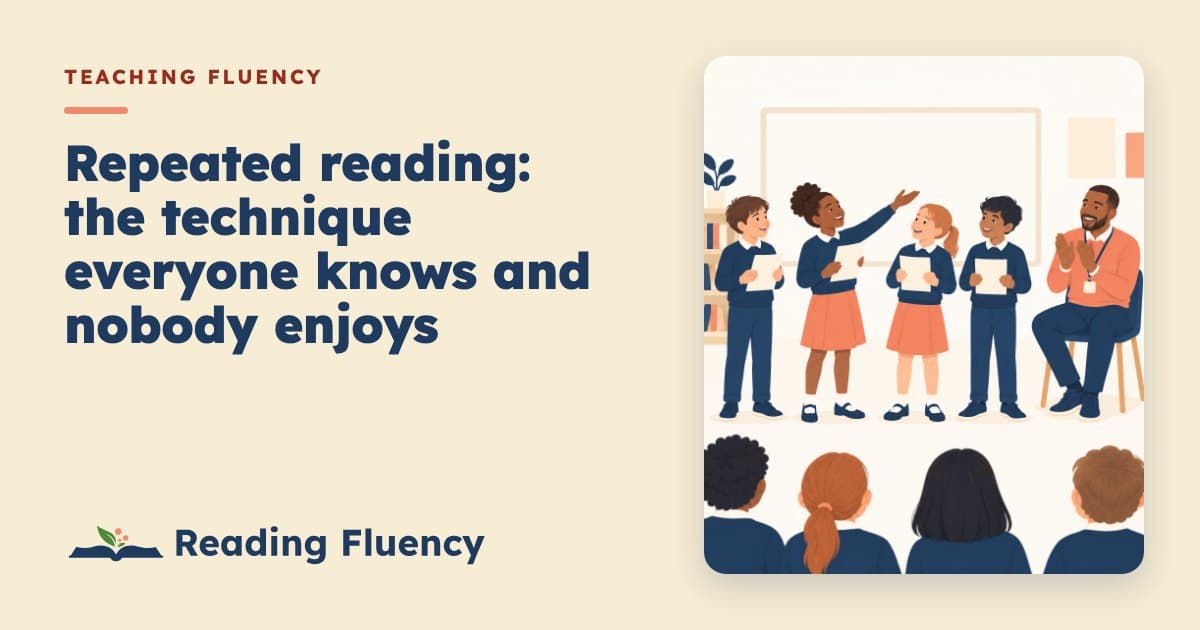
Show it closes the week. On day five the children perform the poem, to a partner, a small group, or the whole class, having practised the very voices they are now using. The performance gives the whole week its purpose. The children were not rereading a poem five days running. They were rehearsing towards this, and rehearsal is repeated reading that nobody resents.
By Friday, a child has read that poem more times than any timed-repetition routine would ever ask of them, and enjoyed it, because the repetition was hidden inside a week of varied, purposeful tasks with a performance at the end.
The evidence that it works
This is not just a nicer way to spend the week. When we measured fluency across a term using this approach with our own Year 2 children, thirty-two of them gained an average of twelve words per minute in four months, with accuracy rising to 98.5%, and the children we had worried about most made the largest gains. The routine delivers the fluency that repeated reading promises, without the joylessness that makes most schools give up on it.
Where to see the full routine
The day-by-day version, with the exact structure for each of the five days and the reason behind every step, is set out in our poem of the week routine. The full write-up, with a downloadable planner, is in the poem of the week post. If you take one idea from this piece, let it be this: repeated reading was never the problem. Doing it without a reason to return was. Give children a reason, change it each day, and the most evidenced fluency technique there is becomes the part of the week they look forward to.
Tags:

Stay in the loop
Weekly reading fluency insights from a serving headteacher. No spam, just practical strategies for your school.
Related Articles
Whole Texts, Not Extracts: The Case for Finishing the Book
Most reading practice is a slice of a book nobody finishes. The evidence says whole texts build comprehension, fluency and joy in ways an extract never can.
Why more reading comprehensions won't fix comprehension
I introduced phonics in four schools and prepared Year 6 classes for their reading SATs. Here's what I learned about why comprehension worksheets don't do what we hope, and what actually builds understanding.
Your phonics results look great. So why is reading still hard work for some children?
Passing phonics proves a child can decode. It does not prove they recognise words instantly, and until they do, reading stays hard work. Here is the automaticity gap, the research behind it, and the flash phrases routine we use at Fetcham to close it.