
Echo Read: why children should copy your voice
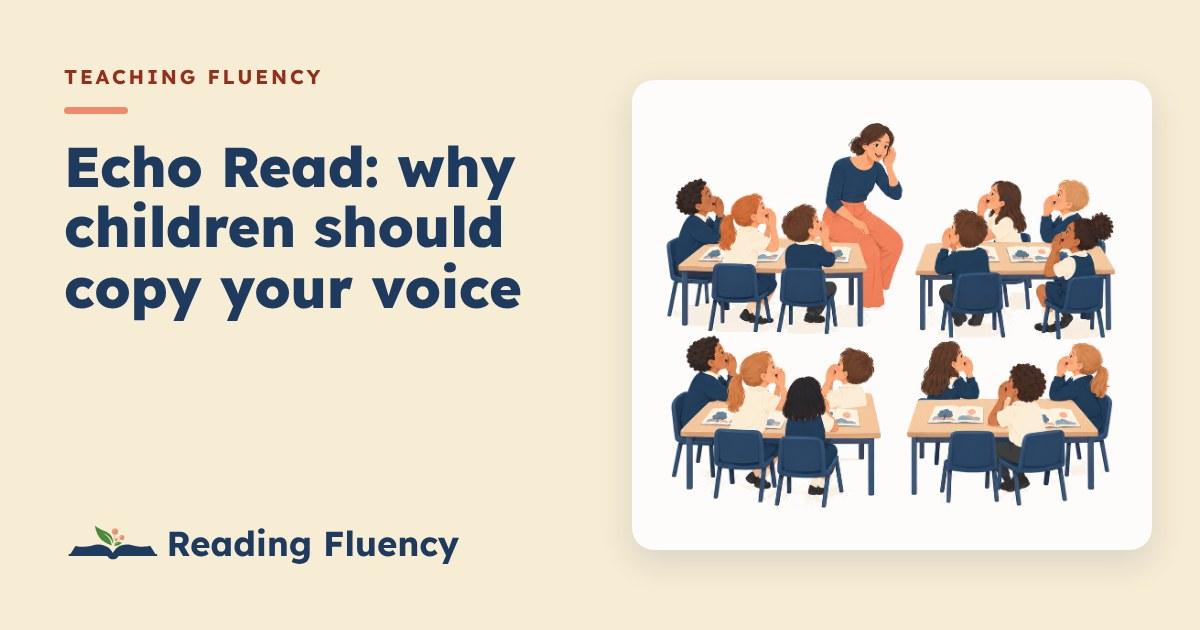
Most children can tell you what good reading sounds like. They hear it from you every day. Ask them to read the same page back, though, and what comes out is often flat. Every word right, every word the same weight, the full stops ignored.
They were listening. The trouble is that by the time it's their turn, your voice has gone. You read a page, they read the page, and somewhere in between the model fell out of their heads. All they kept was the words.
Echo Read closes that gap. You read a line. They read it straight back. Prosody and all.
Why it works
We spend years telling children not to copy. For prosody, copying is the lesson.
Prosody is the music of reading: the phrasing, the pauses, the words that take a little weight, the rise and fall that tells you the reader knows what's happening.
A child can't produce prosody they've never heard, and they can't hold on to prosody they heard two minutes ago across a whole page. One line, heard and then said straight away, is short enough to keep. Timothy Rasinski has made the case for decades that children need to hear fluent reading before they practise it, and echo reading is one of the simplest ways he describes of doing that (The Fluent Reader, 2010).
It gives you something else too. Every child reads every line, and you hear the result in the same second. If the echo comes back flat, you know now, not at the end of the half term. When did you last hear a whole class read a line back exactly the way you read it?
How it runs
On a first meeting with a text, three moves are the whole of it:
- Chunk it. Line by line for a poem. Short phrases for prose. Keep each chunk short enough to hold in their heads.
- Model the line. Read it with full prosody. Keep it full on the tricky words too, because that's exactly where children expect you to go flat.
- Echo it back. The children read the same line straight back, copying your voice.
That's it. A couple of minutes on a short passage. On our Story Trail books, the children echo each new Anchor Passage twice through on the day they first meet it. In the Scout plan it even has a name the children can use: Echo the Gecko.
The common mistake
Chunks that are too long. Give a class a whole verse to echo and they'll spend the echo remembering the words. Prosody is the first thing to go, because their memory is busy. If you're getting the words back but not the voice, shorten the chunk before you try anything else.
Two smaller ones. Don't accept a flat echo. If the words are right and the voice is wrong, do it again, cheerfully. Children learn very quickly whether near enough will do.
And don't echo everything forever. Echo Read is a bridge. Its job is to get the voice into children's mouths, so they can take it into reading together, then to a partner, then on their own. It isn't a place to live.
Try it this week
Pick a poem your class already likes, eight lines or so. Echo it line by line. Then listen for one thing only: do the full stops come back?
If you want the rest of the routine, it's the third move in the Playbook in The Reading Fluency Handbook. That includes what to do on a later day, when only a few lines wobble, and what to do when a line still comes back wrong after you've patched it.
Rasinski, T. V. (2010). The Fluent Reader: Oral and Silent Reading Strategies for Building Fluency, Word Recognition and Comprehension (2nd ed.). Scholastic.
Got questions about Echo Read?
Drop me an email: simon@readingfluency.co.uk
Or find me on LinkedIn: Simon Sharp
Tags:

Stay in the loop
Weekly reading fluency insights from a serving headteacher. No spam, just practical strategies for your school.
Related Articles
Whole Texts, Not Extracts: The Case for Finishing the Book
Most reading practice is a slice of a book nobody finishes. The evidence says whole texts build comprehension, fluency and joy in ways an extract never can.
Repeated reading: the technique everyone knows and nobody enjoys
Repeated reading is the most evidenced fluency technique there is, and the most boring as usually taught. The fix: hide the repetition inside a week of varied, purposeful tasks with a performance at the end.
Why more reading comprehensions won't fix comprehension
I introduced phonics in four schools and prepared Year 6 classes for their reading SATs. Here's what I learned about why comprehension worksheets don't do what we hope, and what actually builds understanding.