
Whole Texts, Not Extracts: The Case for Finishing the Book
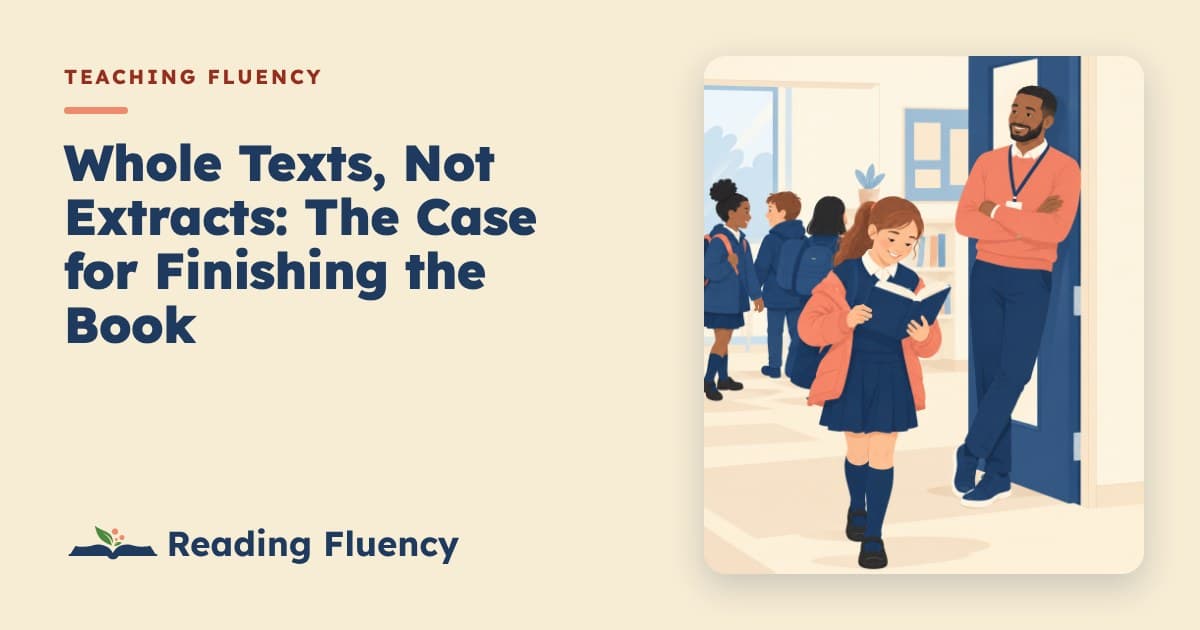
It's twenty past two in a Year 4 classroom and the children are leaning in. The main character has just found the letter. I turn the page, and the bell rings. The class does not find out what the letter said. The book is an extract, and there is no next page.
I've taught reading lessons like that. I suspect most of us have: a slice of a book nobody finishes. The reasons are not cynical. Time is short. Resources are built to be used in small units. And a long habit of teaching and testing short extracts has, in places, steered the reading curriculum toward a series of stops rather than a journey.
What the extract takes away
Comprehension is not a single skill that switches on when a child opens any page. It is building a mental model of the whole text. For that, a child needs to know who the characters are, what is at stake, what happened in the early chapters that makes the ending make sense. An extract strips that scaffolding away. Children are handed a page and asked to infer from evidence that is not on it, because the setup they need lives three chapters earlier. A child can be marked wrong for a failure the layout of the lesson all but guaranteed.
The Department for Education's Reading Framework makes the point plainer than I can. A reading lesson, it says, should help children build a mental model of what they have read. The national curriculum reaches the same place from the listening side: by lower key stage 2, pupils should continue to have opportunities to listen frequently to stories, poems and non-fiction, "including whole books and not just extracts". That is the reading I mean, and it is why a whole book matters: it gives every child's mental model somewhere to live.
The study that should change practice
Westbrook and colleagues (2019) report what happened when 20 English teachers in ten schools read two whole, challenging novels with their Year 8 pupils over twelve weeks, mostly aloud, at a brisk pace, in ordinary lessons. On standardised comprehension tests the pupils made on average 8.5 months' progress in those twelve weeks. The poorer readers made sixteen months' progress: these were the pupils whose reading age was more than twelve months behind their actual age. Say that again slowly. Sixteen months of comprehension progress in twelve weeks, from reading two whole books.
Westbrook and colleagues argued that a long trend of teaching and testing short extracts had left teachers less practised at whole-text comprehension. That rings true, and it is not an accusation: most of us were schooled to teach reading that way, myself included. Two limits are worth owning before anyone builds a plan on this. It is secondary-aged, not primary. And both groups read whole novels, so there was no extracts-only comparison group to set the gains against.
Fluency is built from whole texts
This is where fluency earns its place in the argument (you had to know that was coming sometime, right?). Ofsted's 2024 English report observed that pupils who cannot yet read fluently are often completing written comprehension tasks on extracts, usually in guided reading. What actually builds fluency, Ofsted said, is reading the text repeatedly, being monitored by an adult when reading aloud, rehearsing reading with prosody, and reading more whole texts.
At school I've watched a child who can't hold a page of an extract in their head carry a whole book home after the third chapter. That pull is the thing an extract can't manufacture. It is fluency and comprehension arriving together, because the child is reading for what happens next rather than for the questions.
Joy is not a bonus
The National Literacy Trust's 2026 survey asked 125,375 children and young people aged five to eighteen about their reading. Among eight-to-eighteen-year-olds, 36.1 per cent said they enjoyed reading in their free time, up a little from last year's twenty-year low but still low. And among five-to-eight-year-olds, enjoyment fell slightly in 2026, driven by a drop in boys' enjoyment. Enjoyment is not a soft metric. Children who enjoy reading are ten times more likely to read daily: 49.8 per cent against 4.5 per cent. And Sullivan and Brown's long-running cohort analysis linked reading for pleasure at age ten and sixteen to greater progress in vocabulary, spelling and maths, an effect roughly four times the advantage of having a parent with a degree. That is correlational, so the honest word is linked, not caused. Falling in love with reading needs a story long enough to fall into.
Short passages still have their place
A whole poem or a complete short story is a whole text, and a short, complete, purpose-built passage is exactly right for assessing and practising fluency. Our Dawn Chorus poem-of-the-week routine is built around a short poem, and our assessment passages are built around short, complete texts that are not extracts. But the reading we argue for runs to whole books and, in some cases, whole series. The problem is not the short text. The problem is a reading diet of fragments cut from books the children never get to finish.
What you can do on Monday
None of this needs new resources. On Monday, with the books already in the building, a teacher can:
- read a class novel at a pace that keeps the story alive, and finish it;
- use re-reading for fluency, aloud, with an adult listening;
- if an extract is the only route to a book, hand pupils the whole thing afterwards.
Then, once a term, look honestly at the timetable and ask the question that matters: how much of this week's reading time actually settled on a complete text? There is nothing grand about any of this; it is simply the ordinary texture of a reading week when the book is the point.
Why it matters
Whole texts matter because they are where fluency, comprehension and the love of reading stop being three separate lessons and become one habit. That belief runs through what we write and publish, from poems a child can read from cover to cover to the Story Trail books and the Handbook. And the children from twenty past two? This time they get the whole book, and the bell does not stop them finding out what the letter said.
Tags:

Stay in the loop
Weekly reading fluency insights from a serving headteacher. No spam, just practical strategies for your school.
Related Articles
Repeated reading: the technique everyone knows and nobody enjoys
Repeated reading is the most evidenced fluency technique there is, and the most boring as usually taught. The fix: hide the repetition inside a week of varied, purposeful tasks with a performance at the end.
The SATs Reading Paper Is a Fluency Test in Disguise
Why the KS2 reading paper is often a test of reading fluency rather than comprehension, and how we can best support our pupils.
Comprehension Questions Don't Teach Reading
Comprehension questions don't build reading fluency. Ofsted said it. The DfE said it. The research has said it for years. And yet walk into almost any Key Stage 2 classroom and what will you find? Children answering questions about texts they can barely read aloud.