
Your phonics results look great. So why is reading still hard work for some children?
You see it most clearly in the gap between two moments.
In the first, a child decodes a tricky word on a flashcard. Sounds it out, blends it, gets there. You tick it off. Phonics, working as it should.
In the second, that same child meets the same word inside a sentence a week later, and stalls. Reads it like it's brand new. They decoded it last week. This week they can't recognise it on sight.
At Fetcham, more than 90% of our children have passed the phonics screening check two years running now. I'm proud of that, and I still am. But a proportion of those same children still read word by word, slowly and effortfully, and lose the thread of the sentence before they reach the full stop. Passing phonics proves they can decode. It doesn't prove they recognise words instantly. And until they do, reading stays hard work.
That distinction sits at the heart of how reading actually develops, and it isn't new thinking. The DfE's own Reading Framework names it plainly: accuracy and automaticity are the two components of fluent word reading, and weak fluency holds back comprehension across the curriculum. Skilled readers, the framework notes, read automatically and effortlessly, and children need years of practice to get there.
The research behind that goes back to David LaBerge and Jay Samuels in 1974, in a paper that has shaped fluency research ever since. Their argument was simple and durable. A child does two jobs when reading: recognises the words, and grasps the meaning. Attention is finite. If recognising the words still takes effort, the child has little left over for meaning. Fluent readers recognise words quickly and without conscious effort, so they can spend their attention on understanding. Less fluent readers spend everything they have just getting the words off the page.
So accuracy is not the finish line. Automaticity is. A child can read accurately and still labour over every line, worn out by the act of reading. Accuracy says they can do it. Automaticity says they can do it without breaking stride.
The useful follow-on question is how children build that automaticity in the first place. Here Gordon Logan's instance theory, set out in 1988 and applied to reading in 1997, gives a clear answer. Logan argued that automaticity isn't a switch that flips. Children build it from memory, one trace at a time. Every time a child meets a word, they store another instance of it, and the more instances they store, the faster they recognise it, because they have more examples to draw on and they retrieve them more quickly. Practice works not because it drills some abstract skill, but because each repetition stores another instance.
Two things follow from that, and both matter for the classroom. The first is that repetition isn't optional. It's the mechanism. A word a child has met three times is not yet automatic; a word they've met thirty times, in varied contexts, usually is.
The second is that consistency matters as much as volume. Logan was clear on this. Children need repetitions reliable enough that what they retrieve actually helps them. Scattered, occasional exposure builds automaticity slowly. Frequent, structured, predictable practice builds it fast.
Which brings me to something we do at Fetcham, and the reason I'm writing this.
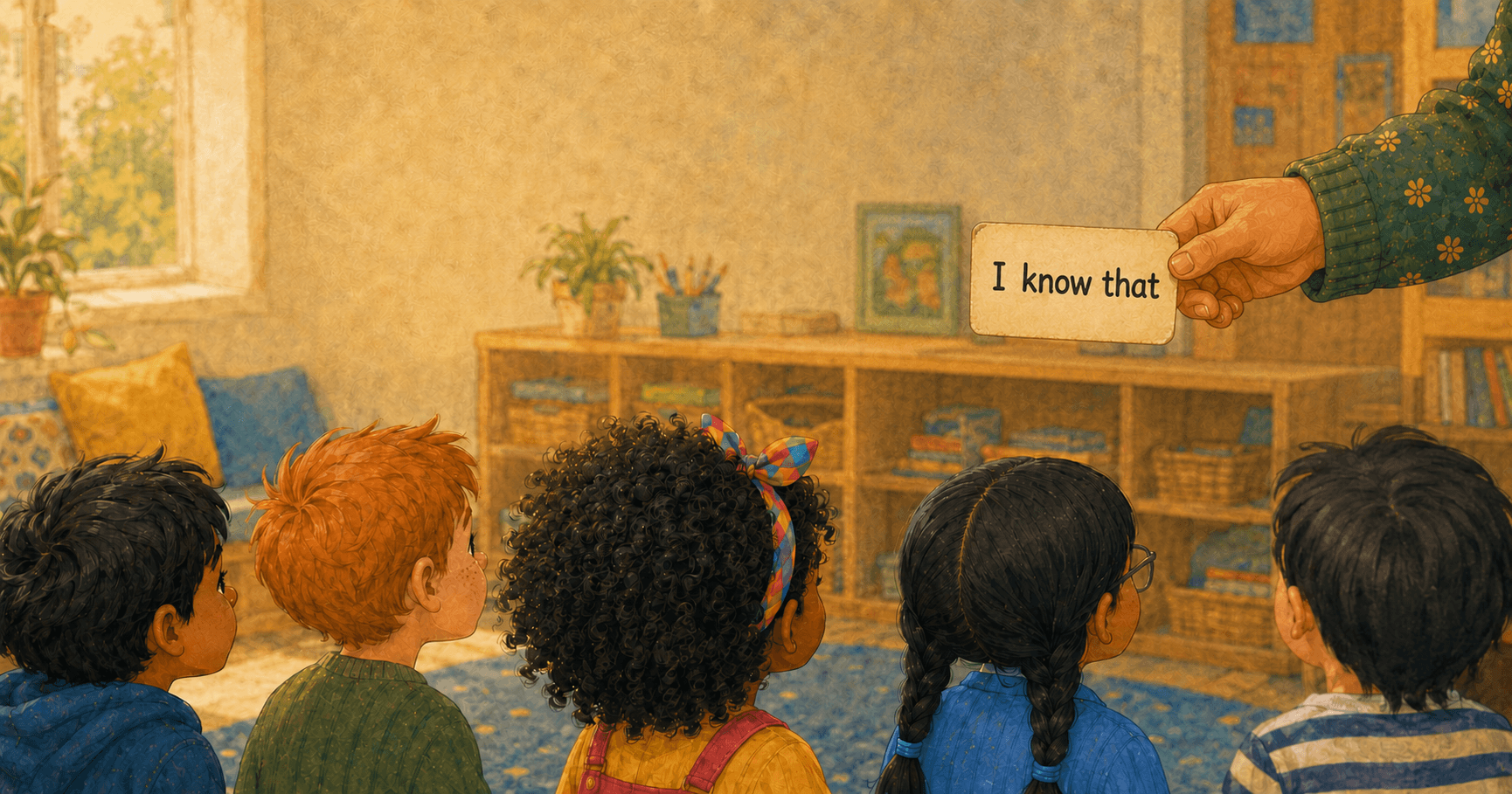
We call them flash phrases. They aren't single words and they aren't full sentences. They're the small, high-frequency chunks that recur constantly in early reading: “I know that”, “next to me”, “light and dark”, “we need more”. Some are pure connective tissue, some carry real meaning, but all of them should come instantly, so children can spend their attention on the words around them that don't.
There's a second reason they work. Reading a phrase as a single unit is itself a step up from reading word by word. When a child takes in “next to me” or “a long time” in one go, they start to group words the way fluent readers do, rather than stopping at every space. So flash phrases build two things at once: instant recognition of the words, and the habit of reading in meaningful chunks rather than one word at a time.
The routine is deliberately tight, and it runs in a few minutes. We start with my turn, your turn: I model the phrase, the children echo it. Then we whizz through the cards at pace, the whole class reading each phrase as it appears, faster than feels comfortable. Then the children go to their tables and practise on partner cards, partner one reading to partner two, then swapping. Finally, fastest finger, where I call out a phrase and they race to point to it on their cards as quickly as they can.
That last step is the one children ask for by name. They treat it as a game. I treat it as Logan's theory in action. Every round stores another instance, sharpens another trace, shaves another fraction off how long recognition takes. The pace is the point. We don't ask them to sound the phrases out. We ask them to recognise them on sight, which is exactly what has to become automatic before reading can flow.
And we keep it consistent, in Logan's sense. Same structure, several times a week, predictable enough that the practice compounds rather than scatters.
I'm not claiming flash phrases solve everything. Nothing in reading does. Decoding still comes first, and phonics still does the foundational work. But there's a stage after accuracy and before fluency that often goes unaddressed, because the phonics data looks healthy and everyone assumes the job is done. That's the stage where children either build automaticity or quietly skip it. Flash phrases are one small, cheap, repeatable way to build it.
If you want to try them, we've put our flash phrase cards, and the rest of the resources we use, on the site. And if you'd rather make your own, a set of self-made cards and five minutes a few times a week works too.
The thing I'd leave you with is the reframe. When you look at strong phonics results, the question worth asking isn't “can they read these words?” It's “do these words still take them any effort?” That second question is where fluency quietly takes hold, or quietly stalls.
Tags:

Stay in the loop
Weekly reading fluency insights from a serving headteacher. No spam, just practical strategies for your school.
Related Articles
The Year 8 Reading Test: Why Primary Schools Should Care
The government has announced a statutory Year 8 reading test assessing fluency and comprehension. The children it will measure are in your school now, and the gap it will find is set long before Year 7.
Repeated reading: the technique everyone knows and nobody enjoys
Repeated reading is the most evidenced fluency technique there is, and the most boring as usually taught. The fix: hide the repetition inside a week of varied, purposeful tasks with a performance at the end.
Why more reading comprehensions won't fix comprehension
I introduced phonics in four schools and prepared Year 6 classes for their reading SATs. Here's what I learned about why comprehension worksheets don't do what we hope, and what actually builds understanding.