
Stop Making Fluency Harder Than It Needs to Be
Here's something I keep seeing in schools - including my own, before we changed our approach.
Children who know all their sounds. Children who can decode any word you put in front of them. Children who sailed through the phonics screening check.
But hand them an "age-appropriate" text and watch what happens. The reading slows to a crawl. Every word becomes effortful. By the end of the page, they've forgotten how it started.
Not every child, of course - some develop fluency naturally through wide reading. But many have cracked the code and still read word-by-word. Their reading sounds effortful even when it's accurate. And for these children, we've been getting it wrong.
We've been trying to build their fluency with texts that are too hard. And it doesn't work.
The cognitive science is clear
Timothy Rasinski describes the real goal of phonics instruction as getting children "to the point where they don't have to use phonics much in their reading." If children are still consciously sounding out words, they can't read fluently. Their working memory is doing two jobs at once – decoding and comprehending – and failing at both. Understanding the three components of fluent reading helps explain why this matters so much.
This is why "age-appropriate" texts so often fail our developing readers. We give them material pitched at their chronological age rather than their fluency level, and wonder why they never develop flow. The answer is obvious once you see it: they're too busy decoding to practise being fluent.
What we're doing at Fetcham
At Fetcham Village Infant School, we've stripped fluency practice back to its essentials.
Poetry and rhyme for choral reading. Short, rhythmic, predictable. The rhyme scheme carries children forward. Crucially, children hear a fluent model first - they get to listen to what it should sound like before they're asked to produce it themselves. Then we read together, the whole group, before anyone reads alone.
There's something else the choral reading does: it strips away the social anxiety. The child who dreads being asked to read aloud? Their voice blends into the group. They can practise without exposure. They can build confidence without risk. By the time they read individually, they've already succeeded multiple times.
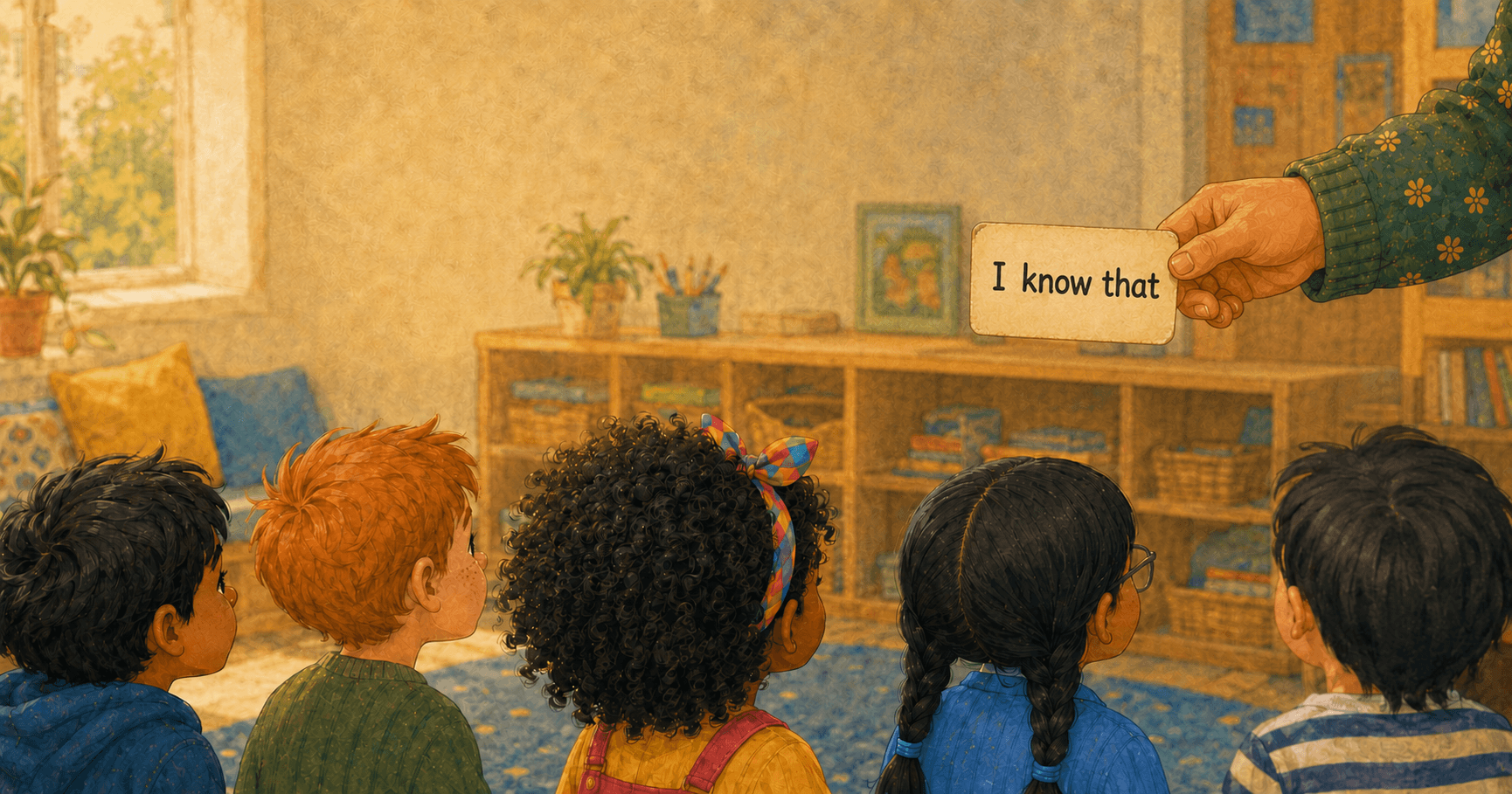
High-frequency word phrases - not isolated words, but short phrases children will meet constantly in their reading. "I went to the" rather than just "went." We practise these in a simple pattern: my turn, our turn, your turn. Teacher models first - children hear fluent reading. Everyone together - safe, supported practice. Then individual children - by which point they've already heard and produced the phrase successfully.
It looks almost too simple. That's exactly why it works.
These approaches work across KS1 and KS2. In KS1, the emphasis is on building automaticity with high-frequency words and simple phrases. In KS2, the same principles apply but with age-appropriate poetry and prose.
The research backs this up
Rasinski's work on assisted reading shows that children hearing fluent reading while following along leads to significant gains in fluency and overall reading achievement. The modelling matters.
His work on repeated reading demonstrates that fluency improves through multiple readings of the same text - not through exposure to increasingly difficult material. The automaticity develops through practice, not challenge.
Young and Rasinski's 2018 study on readers' theatre found that Year 2 children who participated showed significantly larger effects on word recognition automaticity and prosody compared to the control group. The 2019 follow-up research confirmed improvements in reading comprehension too.
The pattern is consistent across the literature: texts children can read easily, practised repeatedly, with fluent models to learn from and safe spaces to practise.
The uncomfortable truth
We persist with phonics-style decoding practice long after children have cracked the code. We push them into texts that are "appropriately challenging" when what they actually need is appropriately easy.
Fluency practice is different from reading instruction. It requires texts children can read without effort – so they can practise reading with expression, pace and meaning. If they're still working hard on the words, they're not practising fluency. They're practising struggle. Whether reading fluency practice is happening in KS1 or KS2, the principle is the same: texts children can read easily, practised repeatedly.
For the many children who know their sounds but find "age-appropriate" texts laborious, try this: make it easier, not harder. It starts with assessing fluency to identify which children need this approach.
You might be surprised what happens. You may also find the connection between fluency and reading enjoyment helps explain why this work is so worthwhile.
References
Kuhn, M. R., & Stahl, S. A. (2003). Fluency: A review of developmental and remedial practices. Journal of Educational Psychology, 95(1), 3–21.
LaBerge, D., & Samuels, S. J. (1974). Toward a theory of automatic information processing in reading. Cognitive Psychology, 6(2), 293–323.
National Institute of Child Health and Human Development. (2000). Report of the National Reading Panel: Teaching children to read. U.S. Government Printing Office.
Rasinski, T. V. (2003). The Fluent Reader: Oral reading strategies for building word recognition, fluency, and comprehension. Scholastic.
Rasinski, T. V. (2010). The Fluent Reader (2nd ed.). Scholastic.
Rasinski, T. V. (2012). Why reading fluency should be hot! The Reading Teacher, 65(8), 516–522.
Rasinski, T. V., Reutzel, D. R., Chard, D., & Linan-Thompson, S. (2011). Reading fluency. In M. L. Kamil, P. D. Pearson, E. B. Moje, & P. P. Afflerbach (Eds.), Handbook of Reading Research (Vol. 4, pp. 286–319). Routledge.
Young, C., & Rasinski, T. (2009). Implementing readers theatre as an approach to classroom fluency instruction. The Reading Teacher, 63(1), 4–13.
Young, C., & Rasinski, T. (2018). Readers theatre: Effects on word recognition automaticity and reading prosody. Journal of Research in Reading, 41(3), 475–485.
Young, C., Durham, P., Miller, M., Rasinski, T. V., & Lane, F. (2019). Improving reading comprehension with readers theater. The Journal of Educational Research, 112(5), 615–626.
Got questions about fluency practice?
Drop me an email: simon@readingfluency.co.uk
Or find me on LinkedIn: Simon Sharp
Tags:

Stay in the loop
Weekly reading fluency insights from a serving headteacher. No spam, just practical strategies for your school.
Related Articles
Repeated reading: the technique everyone knows and nobody enjoys
Repeated reading is the most evidenced fluency technique there is, and the most boring as usually taught. The fix: hide the repetition inside a week of varied, purposeful tasks with a performance at the end.
Why more reading comprehensions won't fix comprehension
I introduced phonics in four schools and prepared Year 6 classes for their reading SATs. Here's what I learned about why comprehension worksheets don't do what we hope, and what actually builds understanding.
Your phonics results look great. So why is reading still hard work for some children?
Passing phonics proves a child can decode. It does not prove they recognise words instantly, and until they do, reading stays hard work. Here is the automaticity gap, the research behind it, and the flash phrases routine we use at Fetcham to close it.