
Reading fluency activities for KS1 and KS2
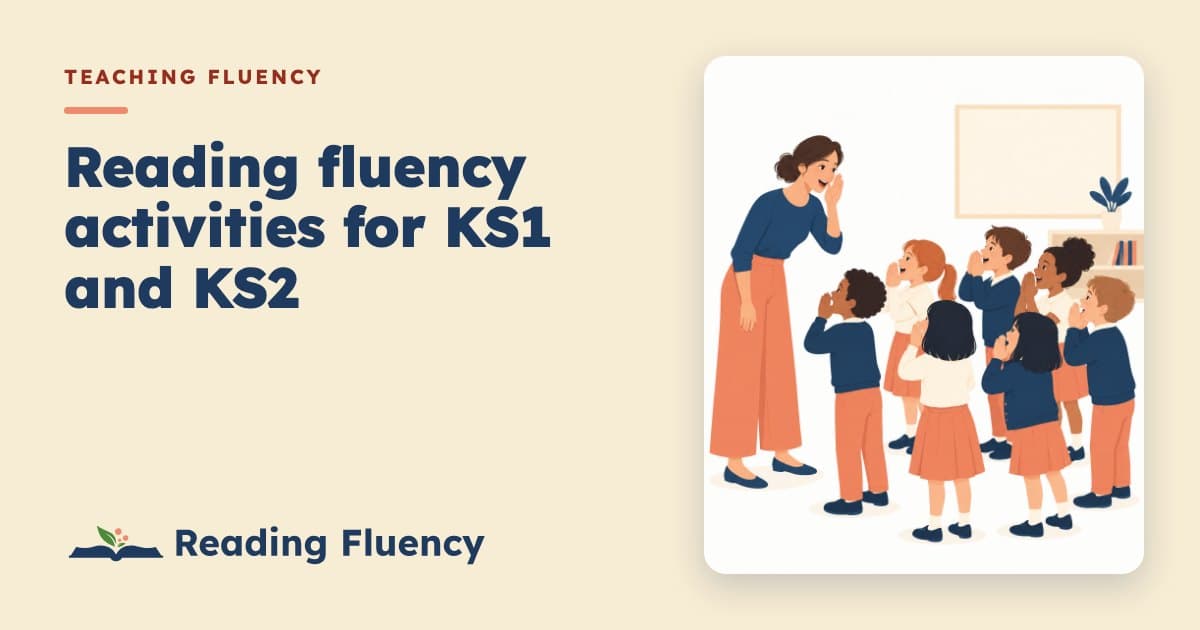
These are eight reading fluency activities you can use this week, with no special equipment and very little preparation. They suit Year 2 through to Year 6, and several work well with younger children too. Each one builds at least one of the three strands of fluency: accuracy (reading the words correctly), automaticity (reading them instantly) and prosody (reading them with expression). You do not need to do all eight. Two or three, done regularly, will move fluency further than a long list done once.
Each activity below is an overview. Most can be broken down into far more detail, and we will be adding fuller guides to several of them over time. If you want the thinking behind why these work and in what order to prioritise them, that sits in the companion guide on how to improve reading fluency in KS2.
1. Echo reading
What it is: you read a short section aloud in a particular way, and the children read it straight back, matching not just the words but the manner of your reading.
How to do it: the skill here is in the kind of expression you model. Read a line as a character who is frightened and speaking quickly. The children echo it, fast and breathless. Read the next line as someone weary and slow, and they match that. You are not just asking them to "read with expression", you are showing them that expression carries meaning, and that a stressed character sounds different from a calm one. Keep the chunks short at first, a line at a time, then build up.
Year group: Year 2 to Year 6, and the best starting point of all eight.
Why it works: the child copies a fluent, characterful model while it is fresh in their ear, which builds prosody far faster than asking them to find the expression cold.
2. Paired reading with a feedback frame
What it is: two children read the same text and give each other one specific, kind piece of feedback.
How to do it: child A reads a short passage to child B. B offers one tip, framed positively, then A reads it again with the tip in mind, and they swap. The feedback frame is what makes this work. Without a structure, children say "that was good" and nothing changes. We use a specific frame at ReadingFluency that gives children the words to offer useful feedback kindly, which you can find here.
Year group: Year 2 to Year 6, once children can give feedback kindly.
Why it works: the reader gets immediate, specific guidance and an instant second go, which is repeated reading with a purpose built in.
3. Phrase chunking
What it is: marking a passage into meaningful phrases so children read in groups of words rather than one word at a time.
How to do it: take a short passage and mark the phrase boundaries with a single slash. "There was a dog / in the park / and it was brown." The children read up to each slash in one smooth group, pausing only at the marks, so their voice groups words the way meaning groups them. Once they have the idea, they can mark the phrases themselves before they read. We use this approach in our own anchor passages, and it is one of the most direct ways to break a word-by-word habit.
Year group: Year 2 to Year 5, particularly children stuck reading one word at a time.
Why it works: word-by-word reading is a habit as much as a skill. Chunking retrains the eye to take in groups of words, which is the foundation of automaticity and the thing that frees up attention for meaning.
4. Punctuation voice
What it is: a quick drill that teaches children to let punctuation change how a sentence sounds.
How to do it: write the same short word three ways: "Stop." "Stop?" "Stop!" Ask the children to read all three, making the full stop calm, the question uncertain, the exclamation urgent. Then move to longer sentences from your current text and ask what the punctuation is telling their voice to do. A few minutes is plenty.
Year group: Year 2 to Year 6, scaling up the sentence complexity with age.
Why it works: prosody is the strand schools teach least, and it is the one most tied to comprehension, because you cannot read a sentence with the right expression unless you have understood it. This makes punctuation a cue for meaning, not just a mark on the page.
5. Performance reading
What it is: children rehearse a short text and perform it to an audience. This is the activity with the most depth, and it breaks down into several stages.
How to do it: choose a short text, a poem, a script or a punchy passage. Then work through it in stages. First, decide together how it should sound: where the drama sits, where it slows, where it lifts. Next, assign parts, who reads what, and where the whole group reads as one. Then rehearse across a few sessions, refining the expression each time. Finally, perform it, to a partner group, the class or another year. Each stage is a reason to read the text again, which is where the fluency gain comes from.
Year group: Year 2 to Year 6. Older children handle longer scripts and more parts.
Why it works: rehearsing for a performance is repeated reading that never feels like repetition, because each read has a purpose. It is also where reluctant readers often start to enjoy reading aloud. Poetry is the easiest way in, and I have written up a full week-long routine in the poem of the week post.
6. Record and replay
What it is: children record themselves reading, listen back, then record again.
How to do it: using a talking tin, a talking whiteboard or an iPad, a child records a short passage, listens to themselves, notices one thing to improve, and records a second take. Hearing your own flat reading is more persuasive than any amount of being told. Keep the passages short so the whole cycle is quick.
Year group: Year 2 to Year 6.
Why it works: children cannot always hear their own reading as they do it. Replay gives them the feedback from the outside, and the second take almost always improves, which builds both fluency and confidence.
7. Choral reading
What it is: a group reads the same text aloud together in one voice.
How to do it: this one rewards getting the groundwork right first. Practise echo reading until the children are used to following your model, and get the call-and-response working well with a small group before you try it with the whole class. Start with short sections and build up. Choose a text everyone can decode comfortably, read it together with you leading, then fade your voice so the children carry it. Add one focus each time: landing the rhymes, pausing at the punctuation, matching the mood.
Year group: Year 2 to Year 6.
Why it works: it lets less confident readers experience what fluent reading feels like from the inside, carried by the group, which builds confidence alongside skill.
8. Repeated reading with a comfortable text
What it is: the principle underneath several of the activities above, reading the same text more than once until it becomes smooth.
How to do it: the single most important rule is text choice. The text must be one the child can already decode comfortably, so the work is on smoothness, not survival. A text that is too hard sends a child straight back to word-by-word reading. I have made this argument in full in why making the text harder makes fluency worse.
Year group: Year 2 to Year 6.
Why it works: the first read is effortful, the third is smooth, and that smoothness is automaticity forming. It is the most evidenced fluency strategy there is, as long as the text is at the right level.
Where to start
Do not try to launch all eight at once. Start with echo reading, because it needs no preparation and teaches children to hear and copy expression from the very first session. Once that is routine, add phrase chunking to break any word by word habits, then punctuation voice to build expression further. Those three, done regularly, will take you a long way before you reach for anything else. Fluency responds quickly when it is practised on purpose.
If you would like a simple way to work out which strand each child needs most, our free spot check sets out the signs of a fluent reader, so you can match the activity to the child.
Tags:

Stay in the loop
Weekly reading fluency insights from a serving headteacher. No spam, just practical strategies for your school.
More from the library
How to improve reading fluency in KS2
Reading fluency is the bridge between decoding and understanding. Here is what actually improves it in KS2: the strategies, the methodology we use, and the evidence behind each, from a serving headteacher.
Read moreWhy does my child read word by word? And how to help
If your child sounds out words but reads them one at a time in a flat voice, the missing piece is fluency, not decoding. Here is why word-by-word reading happens and the simple things that help, from a headteacher.
Read more