
How to prepare for the Year 8 reading fluency test: five steps for primary schools
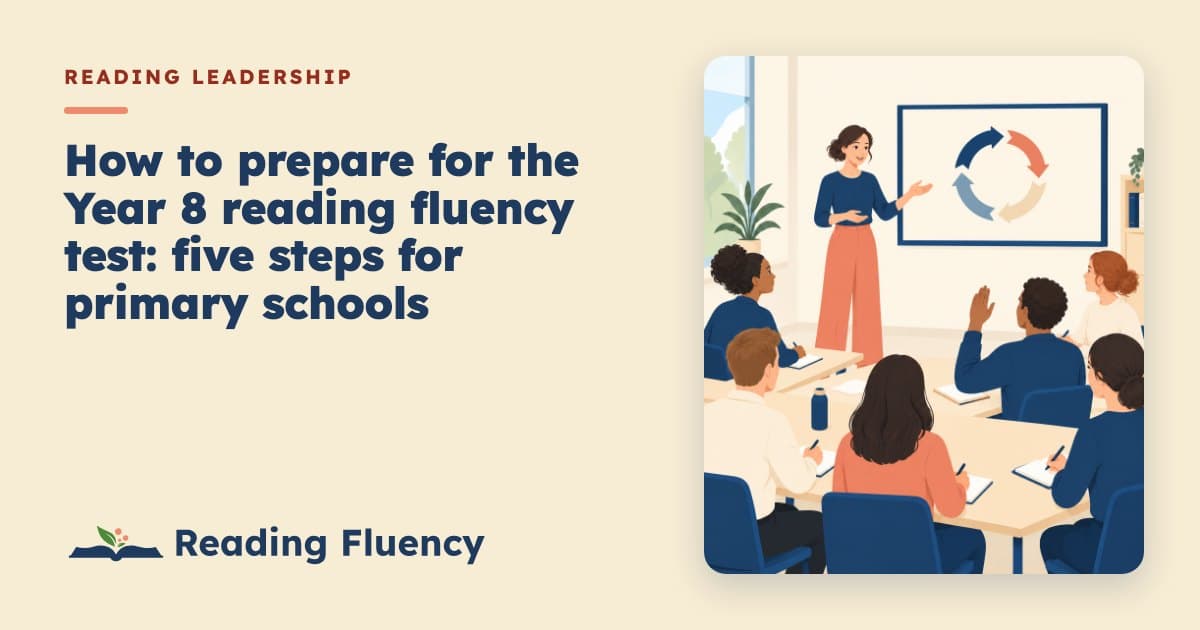
The DfE has announced a statutory Year 8 reading fluency and comprehension test. Your current Year 2s will probably be among the first cohort to sit it. Here is how to make sure they are ready.
I want to say something before we get into the practical steps. If you are reading this thinking "we are not doing enough on fluency," you are not alone. Most schools are not. The system has invested heavily in phonics, and rightly so. But fluency has been left to chance in too many settings. Not because teachers do not care, but because nobody gave them the training, the tools or the time. That is a system failure, not a school one.
1. Audit what you are actually doing on fluency right now
Be honest with yourself. Does your school have a systematic fluency curriculum, or does fluency happen informally? A bit of reading aloud here, some paired reading there? Ofsted's Telling the Story report found that most schools teach phonics well but that the move to fluency and comprehension is less well developed. If fluency is not timetabled, assessed and tracked, it is not systematic. That is not a criticism. It is a starting point.
This applies to infant schools and KS1 settings as much as anyone else. Fluency assessment should begin in Year 1, not Year 3. FFT's data shows that by the end of KS1, the gap between the highest and lowest readers is already substantial. Early identification matters.
2. Start assessing reading fluency, not just comprehension
You almost certainly assess phonics (the screening check makes sure of that) and you probably assess comprehension through test-style questions. But do you assess fluency itself?
Words correct per minute gives you automaticity data. A prosody rubric gives you the other half: does the child read in phrases? With appropriate expression? At a conversational pace? Rasinski's Multidimensional Fluency Scale is a solid starting point. Assess termly from Year 1 to Year 6. The UK Standards and Testing Agency previously suggested 90 WCPM as sufficient fluency for reading for meaning at the end of KS1. Chris Such suggests 110 WCPM is a better threshold. Either way, you need a number and a trajectory. If you are not sure where to start, I have written a step-by-step guide to fluency assessment and a post on what the UK benchmarks actually mean.
3. Build daily fluency practice into every classroom
Not weekly. Daily. Ten minutes is enough.
Choral reading, echo reading, paired reading, readers' theatre, flash phrase cards, poetry performance. Young and Rasinski (2018) showed these approaches improve automaticity and prosody simultaneously. The key is using texts that children can already read without effort. Fluency practice means practising fluency, not struggling with unfamiliar vocabulary. At Fetcham, we use simple texts, poems and performance pieces for exactly this reason. I wrote about why easier texts work better for fluency development.
4. Track reading fluency progression from Reception to Year 6
When your Year 6s transition to secondary, you will need data that tells a story. Not a single assessment point at the end of Year 6, but a journey from Reception baseline through to Year 6 exit. Words correct per minute benchmarks at each stage. Prosody development over time. This is the data that will demonstrate your school took fluency seriously long before the Year 8 test existed.
5. Train your KS2 staff on fluency instruction
The Reading Ambition for All CPD programme is doubling in reach and a new "Unlocking Reading" CPD is launching for secondary schools. But do not wait for external training to arrive. Your Reception and Year 1 teachers know phonics inside out. Your KS2 teachers? Many have never been explicitly trained to teach fluency. Ofsted found that weaker subject knowledge of early reading leads to less effective additional support for pupils. This is not their fault. It is a gap in the training pipeline. Close it now with internal CPD, peer observation and shared practice.
The Year 8 test creates statutory accountability for reading fluency. But the children who will sit it are already in your classrooms. The question is not whether to act. It is whether you have already started.
Next in this series: why Pupil Premium evidence needs to include fluency data, and what happens when it does not.
References
- Department for Education (2026). Every Child Achieving and Thriving. gov.uk
- Ofsted (2024). Telling the Story: The English Education Subject Report. gov.uk
- FFT Education Datalab (2024). Measuring reading fluency during primary education. ffteducationdatalab.org.uk
- Young, C. & Rasinski, T. V. (2018). Readers Theatre: Effects on word recognition automaticity and reading prosody. Journal of Research in Reading, 41(3), 475–485
- Such, C. (2021). The Art and Science of Primary Reading. SAGE
In this series
- What the DfE white paper means for reading fluency in primary schools
- Why reading fluency matters: the research behind the Year 8 test
- How to prepare for the Year 8 reading fluency test: five steps for primary schools (this post)
- Pupil Premium and reading fluency: where is the evidence of impact?
- How to build a Pupil Premium reading fluency evidence trail that holds up
Tags:

Stay in the loop
Weekly reading fluency insights from a serving headteacher. No spam, just practical strategies for your school.
Related Articles
The Year 8 Reading Test: Why Primary Schools Should Care
The government has announced a statutory Year 8 reading test assessing fluency and comprehension. The children it will measure are in your school now, and the gap it will find is set long before Year 7.
Repeated reading: the technique everyone knows and nobody enjoys
Repeated reading is the most evidenced fluency technique there is, and the most boring as usually taught. The fix: hide the repetition inside a week of varied, purposeful tasks with a performance at the end.
Why more reading comprehensions won't fix comprehension
I introduced phonics in four schools and prepared Year 6 classes for their reading SATs. Here's what I learned about why comprehension worksheets don't do what we hope, and what actually builds understanding.